
The editor
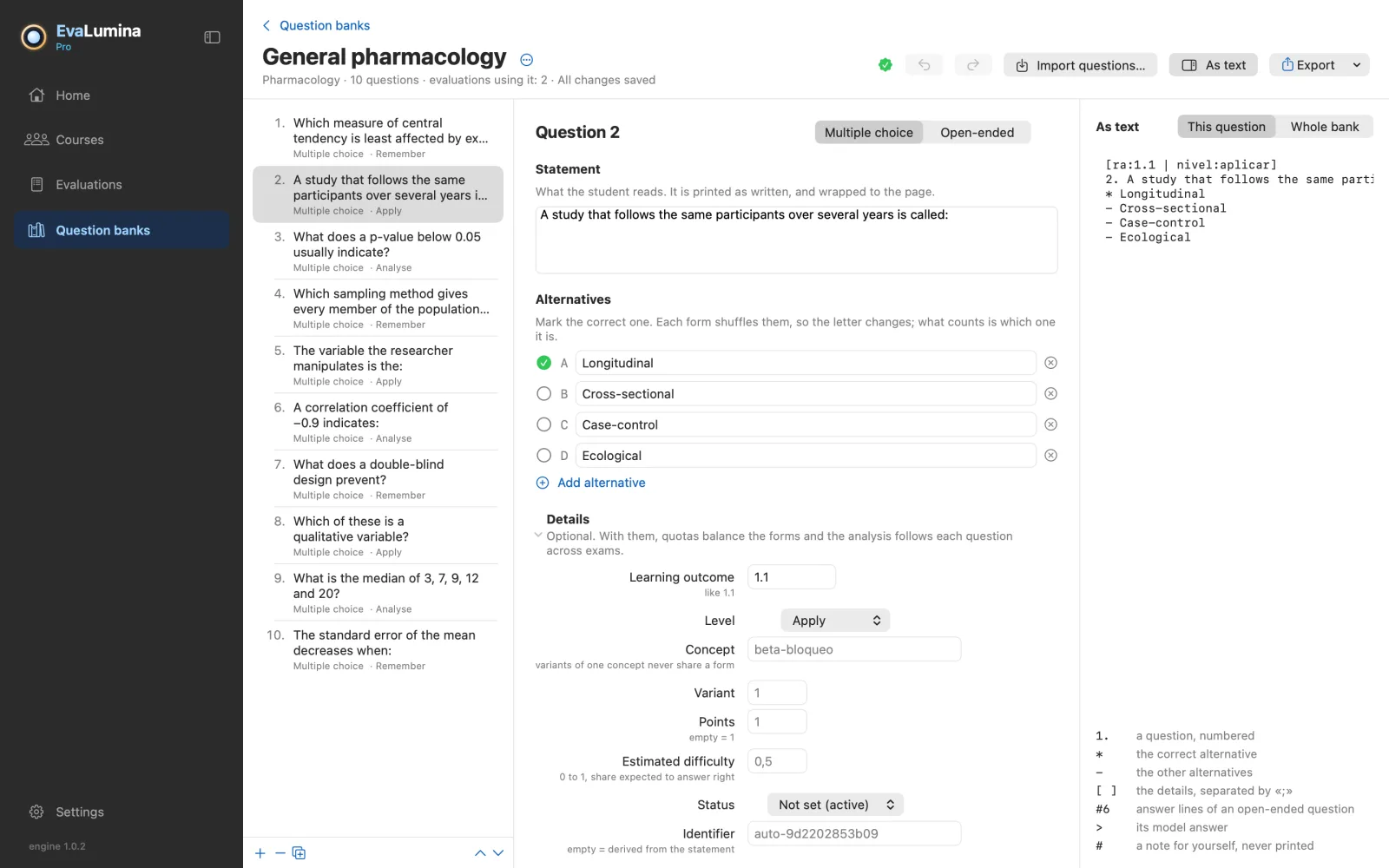
In Question banks → New bank each question is a form: its statement, its alternatives with the correct one marked, and its details. Beside it, As text shows the same question as the text format writes it, so the format is learnt by looking at it.
Every change is saved as you make it and can be undone. Import questions… adds the questions of a .txt file, a bank with its pictures (.zip) or a spreadsheet (.xlsx, .csv). Export writes a copy to share with colleagues.
The text format
A plain text file (.txt), written in any editor. A question starts with its number and a full stop; the correct alternative starts with * and the others with -.
1. Which measure of central tendency is least affected by extreme values?- The mean* The median- The mode- The range- Exactly one alternative is marked with
*, and a question needs at least two. - A statement can take several lines: they are joined until the first alternative.
- Blank lines between questions are optional. The numbers don't need to be in order: each form numbers its questions again.
- A line that starts with
#is a note for you and is never printed. - The answer sheet has five letters, A to E. A question may have more alternatives: each form then prints the correct one and four distractors drawn at random.
Numbered statements
Numbered lines right after the statement, counting from 1, are part of the question, not new questions:
5. Consider the following statements about a p-value below 0.05:1. It proves the null hypothesis is false.2. It indicates a result that is statistically significant at 5%.3. It measures the size of the effect.Which are correct?* 2 only- 1 and 2 only- 2 and 3 only- 1, 2 and 3Fixed order
Alternatives are shuffled on every form. When their order matters, as with “all of the above”, write [orden:fijo] on the line above the question and they are printed as written.
4. Which of these is a measure of dispersion?- The standard deviation- The range- The variance* All of the aboveQuestion details Pro
A line in square brackets just above a question describes it. It is what quotas balance forms with and what the analysis follows from one exam to the next. Fields are separated by | or ;, and they are written in Spanish in every language, as the app writes them.
3. The blood pressure of 200 people is measured every year for a decade. What design is it?* Longitudinal- Cross-sectional- Case-control- Ecological| Field | What it says | How it is written |
|---|---|---|
ra | Learning outcome | Two numbers with a dot: 1.1, 2.3 |
nivel | Cognitive level | recordar (remember), aplicar (apply) or analizar (analyse) |
concepto | The concept several variants share | Lower case, digits and hyphens: beta-blockade |
variante | Which variant of the concept this is | A whole number; 1 if absent |
puntaje | Points | A number; 1 if absent |
dificultad_estimada | Your estimate of how many will get it right | From 0 to 1, with a comma or a dot |
estado | Where the question is in its life | piloto (pilot), activo (active) or retirado (retired) |
id | An identifier of your own | Optional: if absent, the app derives one from the statement |
orden | Keep the alternatives in order | fijo |
Concepts and variants. Variants are questions that share a scenario and change the condition that decides the answer. They give each other away, so a form never carries two variants of the same concept.
The app writes three more fields by itself when it calibrates the bank: dificultad_real, discriminacion and aplicaciones. There is no need to write them.
Blocks
Several questions about one thing (a clinical case, a passage, a chart, a radiograph) are written as a block. The block's text is printed once, above its questions, and they stay together on every form.
@block A clinical trial randomly assigned 120 patients with hypertension to a new drug or to placebo.The main outcome was systolic pressure at 12 weeks.@image trial.png 6. What type of study is it?* Experimental- Observational- Ecological 7. What is random assignment for?* To make the groups comparable, including in what was not measured- To make the study double-blind- To increase the sample size@end@blockopens it and@endcloses it. The text can go on over several lines, and a blank line starts a new paragraph.@imageadds one picture per block. When you import a bank with pictures, bring in a .zip with the .txt and its images; in the editor you add the picture to the block directly.- A block's questions are shuffled among themselves. With
[orden:fijo]on the line above@block, they keep the order written. - The markers are also read in Spanish (
@bloque,@imagen,@fin) and Portuguese (@bloco,@imagem,@fim), so a colleague's bank opens without translating. - Blocks can't be nested, and open-ended questions don't go inside a block.
Open-ended questions Pro
A question with no alternatives, with # and the number of lines the student gets to answer. A line starting with > is the model answer: it helps you mark and is never printed.
8. Explain the difference between statistical significance and clinical relevance.#6> A result can be unlikely to be due to chance and still be too small to matter to the patient.They are printed after the multiple-choice questions, so the bubbles stay numbered from 1. You score them in the evaluation's Open-ended stage, and they are added to the grade.
Excel and CSV
One row per question and one column per part of it. Headings can be in English, Spanish or Portuguese and in any order, and the app recognises the usual names (“Question”, “Answer”, “Option A”...).
| Column | What goes in it |
|---|---|
| Statement | The question. The only column every bank needs. |
| Alternative A … Alternative E | One alternative per column, up to five. |
| Correct | The correct one: its letter (B), its number (2) or its text. |
| Type | Multiple choice or Open-ended. |
| Fixed order | Yes or x to keep the alternatives in order. |
| Points, Learning outcome, Level, Concept, Variant, Estimated difficulty, Status | The question's details, as in the text format. Levels and statuses can be written in any of the three languages. |
| Answer lines, Model answer | For open-ended questions. |
| ID, Notes | Optional. |
A CSV file works the same, with commas, semicolons or tabs. What a spreadsheet can't hold yet is blocks: for those, use the text format.
Examples to download
The same example bank in both formats: a simple question, details, two variants of one concept, fixed order, numbered statements, a block and an open-ended question. Import them in Question banks → Import… and open them in the editor to see each question as a form.
sample-bank.txtsample-bank.xlsx
The spreadsheet has no block, since spreadsheets can't hold them yet.
When a bank is refused
A bank with a mistake doesn't generate exams: that way it never reaches paper. The editor marks the question, and an imported file says on which line the problem is. The most common:
- No alternative marked with
*, or more than one. - A question with a single alternative.
- A block opened with
@blockand never closed with@end, or one inside another. - An
@imagewhose picture was not brought in with the bank. - A detail with a value it doesn't take, such as
nivel:understand.